Key takeaways
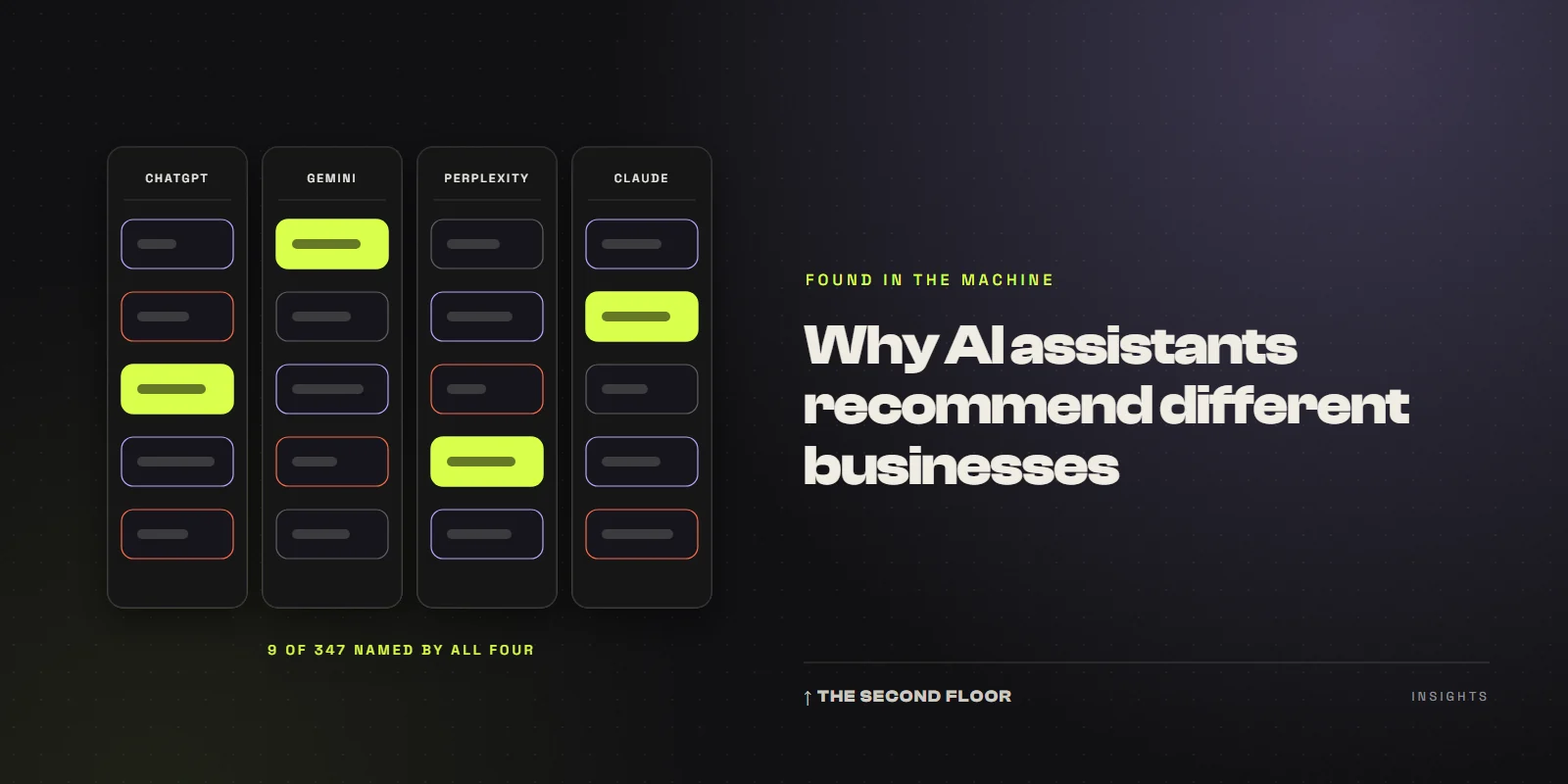
- Each AI assistant searches a different slice of the web and trusts different sources. In our Leicester test just 9 of 347 firms were named by all four.
- Gemini pointed to business websites in 41% of its source links. ChatGPT did so in just 7%, leaning on directories such as Checkatrade instead.
- Each tool had a favourite: ThreeBestRated for Gemini, Bark for Perplexity, Checkatrade for ChatGPT, TrustATrader for Claude.
- Don't optimise for one assistant. Consistent facts, reviews on your trade's directories and clear service pages cover all four.
- Answers also change from one run to the next, so judge your visibility on a monthly pattern across every tool, never a single reply.
Ask four AI assistants the same question and you will often get four different shortlists. That isn’t a glitch. Each assistant searches a different slice of the web, trusts different sources and writes its answer in its own way. Being recommended by one tells you surprisingly little about the others.
We measured how far apart they are. On 4 November 2026 we asked ChatGPT, Gemini, Perplexity and Claude “Who is the best [trade] in Leicester?” for 20 local trades, with web search on. The headline results are in our Leicester study. This piece digs into the part owners ask us about most: why the answers differ, and what to do about it.
How different are the answers, really?
Very. Across the 20 trades the four assistants named 347 different businesses. Only 9 were named by all four. Just 103 were named by at least two, which means most businesses that got a recommendation got it from one assistant only.
They rarely agreed on a first pick either. All four put the same business first in just one trade out of 20 (gyms). And they had different personalities:
| ChatGPT | Perplexity | Gemini | Claude | |
|---|---|---|---|---|
| Business mentions across 20 answers | 103 | 87 | 122 | 177 |
| Answers saying there’s no single “best” | 18 of 20 | 12 of 20 | 13 of 20 | 20 of 20 |
| Source links given | 73 | 200 | 148 | 114 |
| Share of links to business websites | 7% | 13% | 41% | 34% |
| Most-cited source (answers citing it) | Checkatrade (8) | Bark (11) | ThreeBestRated (17) | TrustATrader (5) |
Claude named the most businesses and hedged every time. Perplexity gave the shortest lists but the most sources. Gemini read business websites far more than ChatGPT did. One run, one afternoon, one city, so treat the numbers as a snapshot. The gaps between the tools, though, were too big to be a fluke.
Why do ChatGPT, Gemini, Perplexity and Claude disagree?
Four reasons: different search engines underneath, different taste in sources, different instructions on how to answer, and plain randomness.
1. They search different indexes
Each assistant finds pages its own way:
- ChatGPT runs its own crawler, OAI-SearchBot, to build its search results, and also uses outside search providers. OpenAI’s documentation names Bing and Shopify, and Semrush has shown that ChatGPT sometimes pulls from Google as well.
- Gemini answers using Grounding with Google Search, so it starts from Google’s index.
- Perplexity crawls with PerplexityBot, which it says exists to surface and link websites in its search results.
- Claude uses Claude-SearchBot to index pages for search quality, plus Claude-User to fetch a page when someone asks.
Different indexes mean different pages come back for the same question. If one of those crawlers is blocked on your site, you can vanish from one assistant while looking fine in the others. Our AI crawler set-up guide shows how to check.
2. They trust different sources
Even when they find the same pages, they lean on different ones. In our test, Gemini cited the ranking site ThreeBestRated in 17 of its 20 answers. Perplexity cited Bark in 11. ChatGPT went to Checkatrade most often and was one of only two assistants to cite Reddit. Perplexity sent 21 of its 200 links to trade bodies, awards and regulators, such as the Federation of Master Builders. Claude was the only one to cite Yelp.
So the same business can look strong to one assistant (great Checkatrade profile) and invisible to another (no website worth quoting). We go deeper on review platforms in which review sites AI actually reads, and on those ranking sites in whether “best in town” lists are worth paying for.
3. They’re told to answer differently
Some assistants are built to be cautious and list several options. Others give a tighter recommendation. You can see it in the hedging row above: Claude said there was no single best in every answer, Perplexity in just over half. A longer list gives more businesses a look-in. A shorter one rewards whoever the assistant is most sure about.
4. Every answer is generated fresh
Ask the same question twice and you may get a different list. Small changes in wording, location or timing change what gets retrieved, and the model writes each reply from scratch. That is why we never judge a business on one answer, ours included.
What does that mean for a local business?
Build the shared foundations first, then fill the gaps for the assistants your customers use most.
The shared foundations cover all four:
- The same business name, address, phone number and description everywhere.
- Reviews on the directories your trade actually uses, not only Google.
- A website that says plainly what you do and where, one page per main service.
- AI crawlers allowed in.
Then look at the gaps assistant by assistant. Based on what we saw:
| If this assistant matters to you | Pay extra attention to |
|---|---|
| Gemini (and Google’s AI features) | Your own website, plus credible ranking and directory pages. Our Google AI Mode guide covers Google’s side |
| ChatGPT | Directories like Checkatrade and Which? Trusted Traders, and how you come across on Reddit |
| Perplexity | Marketplaces such as Bark, plus trade body and accreditation listings |
| Claude | A spread of directories and a clear website |
| Microsoft Copilot | Bing. See our guide to Bing for AI search |
Which assistant should you care about most?
The ones your customers open, which for most UK businesses means ChatGPT and Google first.
BrightLocal’s 2026 survey of US consumers found ChatGPT was the most-used AI tool for business recommendations (31%), with Google’s AI Mode second (23%). There’s no UK equivalent yet, but Ofcom’s figures point the same way: 1.8 billion UK visits to ChatGPT in the first eight months of 2025, and AI Overviews on roughly 30% of searches.
That doesn’t make the others irrelevant. Perplexity and Claude have loyal users, and Copilot sits inside Windows and Microsoft 365. Because the foundations overlap so much, the extra effort for each is small.
How do you keep track of four assistants at once?
Ask the same questions in all four every month and record who gets named. Keep the wording identical, use a private window, and switch web search on. Look for patterns over three months, not one answer. Our guide to measuring your AI search visibility gives you a scoring sheet, and local AEO covers the “near me” questions in more depth. For the brand side, what each assistant says when someone asks about you by name, start with what AI says about your business.
Or let us do it. Our free growth review checks how you show up in Google, Google Maps and the main AI assistants, side by side, and tells you which gaps are worth closing first.